MPEG-2 Transport Stream TimeStamp
Introduction to MPEG-2 Transport Stream TimeStamp - program clock reference (PCR), presentation time stamp (PTS) and decoding time stamp (DTS).

MPEG-2 Transport Stream (or just transport stream) is a system level container format to embed video and audio data. The format is heavily used in the broadcast/cable industry like Comcast, Sky etc to transmit video and audio system over IP for two scenarios
- transmit video/audio signal within the cable head-end between broadcast equipments e.g. from QAM to encoder
- transmit video/audio signal from cable head-end to individual subscribed users' set-top box via the private cable network
There are three timestamps in transport stream playing an important role in synchronizing video and audio data perfectly across different part of the broadcast system:
- program clock reference (PCR)
- presentation timestamp (PTS)
- decoding timestamp (DTS)
We hope that after this article you will have a better understanding what they are and how they work in a high level sense.
Buffer overflow and underflow
In high level, transmitting digital video/audio system within the broadcast system is simply a producer and consumer model e.g.
- Encoder as producer - taking in raw video/audio signal, encode it and output transport stream to downstream
- Set-top box as consumer - taking upstream transport stream produced by encoder, decode it back to raw video/audio signal and display on the TV
One criteria for the system to play correctly is to make sure the rate of producing and consuming the transport stream are equal i.e.
- If the rate of encoder producing transport stream is higher than the consumption rate of set-top box. Buffer overflow will be happened on the set-top box, resulting video or audio data lost on TV
- If the rate of encoder producing transport stream is lower than the consumption rate of set-top box. Buffer underflow will be happened on the set-top box, resulting video get stalled on TV
In order to achieve same rate of running, the producer clock frequency must be equal to the consumer clock frequency, this can be done by synchronizing their clock by some timing protocol. In transport stream or the broadcast domain, this clock synchronization is done by the program clock reference (PCR).
Program clock reference (PCR)
The idea using PCR to synchronize the clock between upstream (e.g. encoder) and downstream device (e.g. set-top box) is like this. We can imagine each TS packet produced by the upstream device in real time will have the PCR value set to device's local time before sending to the network. The downstream device receiving these packets extract the PCR value and lock/synchronize to the upstream device clock frequency by phase lock loop (PLL) or some regression technique.
To help you sense the concept; here is an example
- encoder at local time 10 produce first packet and mark the packet PCR = 10
- encoder at local time 20 produce second packet and mark the packet PCR = 20
- set-top box receive the first packet with PCR = 10 from upstream at local time 10
- set-top box receive the second packet with PCR = 20 from upstream at local time 25
Base on 3 and 4, from set-top box's perspective
- the local time difference receiving first and second packet is 15
- the PCR time difference receiving first and second packet is 10
- i.e. set-top clock have advanced by 15 clock unit but upstream only advance by 10 clock unit as represented by the PCR difference
That means the set-top's local clock is running faster than encoder. In order to match upstream clock frequency, the set-top have to reduce the local clock frequency accordingly.
Eventually, the downstream device will have a clock synchronized to upstream in both value and frequency. Given both upstream and downstream devices are running with same clock, we can talk about decoding and presentation timestamp in the MPEG-2 TS.
Decoding timestamp (DTS)
Every compressed video and audio frames produced and packaged into TS will be tagged with decoding timestamp (DTS). As the name have implied, DTS is used to instruct decoder the time to decode the compressed video or audio frames and put into the raw frame buffer. As a result, DTS have several attributes to note:
- DTS run on the same PCR clock time base
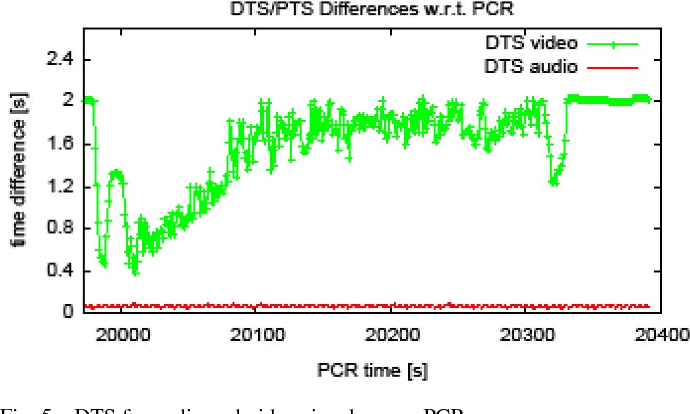
- The first packet of a compressed frame will be attached with DTS and receiving time can be derived with a PCR value. This compressed frame must be fully received between the first packet PCR and DTS; otherwise the compressed frame cannot be decoded at DTS.
- Base on (2), the first packet DTS must be larger than PCR as illustrated below
Presentation timestamp (PTS)
Similar to DTS, every compressed video and audio frames are tagged with presentation timestamp (PTS). PTS is used to instruct the decoder when to display the decoded raw video and audio in the frame buffer to the screen.
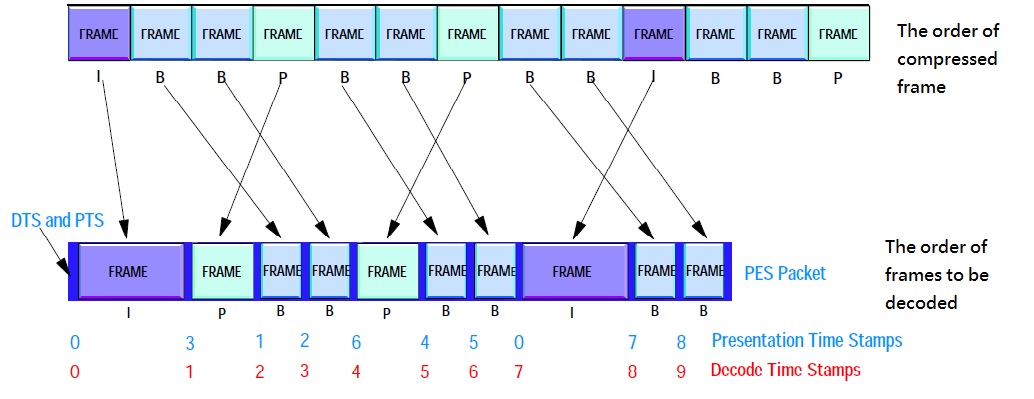
In real world, DTS is required only if frame re-ordering happen i.e. the order of frame transmission is different from the order they display on the TS. This happened on compressed video like AVC or HEVC when B-frame is used to improve the compression efficiency where time to decode and present the compressed video frame is different.
For the example below, the first P frame have been re-ordered and packaged right after the first I-frame in the TS which will be decoded at DTS = 1 and presented at PTS = 3.
For compressed audio or video without B-frame; we can skip DTS to save some bandwidth in transmission.
Summary
In this article , we have gone though the idea in MPEG-2 Transport Stream to synchronize the clock between upstream and downstream via program clock reference (PCR) and how presentation (PTS) and decoding timestamp (DTS) work base on the synchronized time base.
Thanks for reading. Please send me an email at povalab@gmail.com for any comment or questions. I am very happy to get feedkback from you.